
You ask ChatGPT about your category, see your brand, and assume you're covered, until a competitor takes that answer and nobody notices. AI citation tracking catches that. You run a fixed set of prompts across ChatGPT, Claude, Gemini, and Perplexity on a schedule, then score how each one mentions your brand. We cover why it matters in what AI citation tracking is. This piece covers what to count, how to score and benchmark it, and what to fix.
What Counts as a Citation, and What Doesn't
A citation counts when an AI engine names your brand or links to your domain while answering a real question a buyer would ask. That includes being quoted as a source and being named in a comparison. A generic mention of your product category with no brand name attached doesn't count.
The most common misreading of a visibility report is treating being cited and being recommended as the same outcome. A brand can be quoted as a source on a topic and still lose the sale to a competitor named in the same answer. Track both. A high citation count paired with a low recommendation rate often points to thin product and comparison evidence.
The Metrics That Actually Make Up Citation Tracking
Citation tracking isn't one number. Citation Share is your portion of all brand mentions in AI answers against your competitors. Authority Weight is whether the AI frames your brand as an expert source or one of many mentions. Sentiment is the tone of the mention: favorable, neutral, or negative.
If you track sentiment alone and call it citation tracking, you miss whether you're cited at all.
How to Track Citations Yourself
Start with a fixed prompt set covering three question types: brand-direct ("What is [Brand]?"), category ("best [category] for [use case]"), and comparison ("[Brand] vs [Competitor]"). A set built from only one type measures a single slice of visibility instead of the whole thing.
Run that same set across ChatGPT, Claude, Gemini, and Perplexity every month, at minimum. In SISTRIX's AI citation drift study, 56% of the domains AI Mode cites for a prompt in an average week weren't there the week before. The figure is 74% for ChatGPT Search. A single check only tells you what was true that day.
Score each response the same way every time. We cover the full scoring model in what AI search visibility actually measures. In short, our own Three Squared Nine case study scored on four dimensions. Presence is whether the brand appears at all. Position is whether it's the top recommendation or a passing mention. Sentiment is whether the mention is positive, neutral, or negative. Context quality is whether the brand is described accurately. Each score applies to one response, instead of a percentage of your whole prompt set. A response with zero presence scores zero across all four, since there's nothing left to grade for position, sentiment, or context.
Log the source behind every citation, as well as the citation itself. When a model cites your own site, that's a source you control. When it cites a directory, review platform, or competitor's comparison page, that's a source you don't. You can't update that second kind yourself.
What Google Search Console and Bing Webmaster Tools Now Show
Google and Bing now both report AI activity on your own pages for free, though each still labels its report Beta, so expect changes. Each one counts how often its AI features showed your pages. Neither tells you what the answer said about you, so you still need your prompt log.
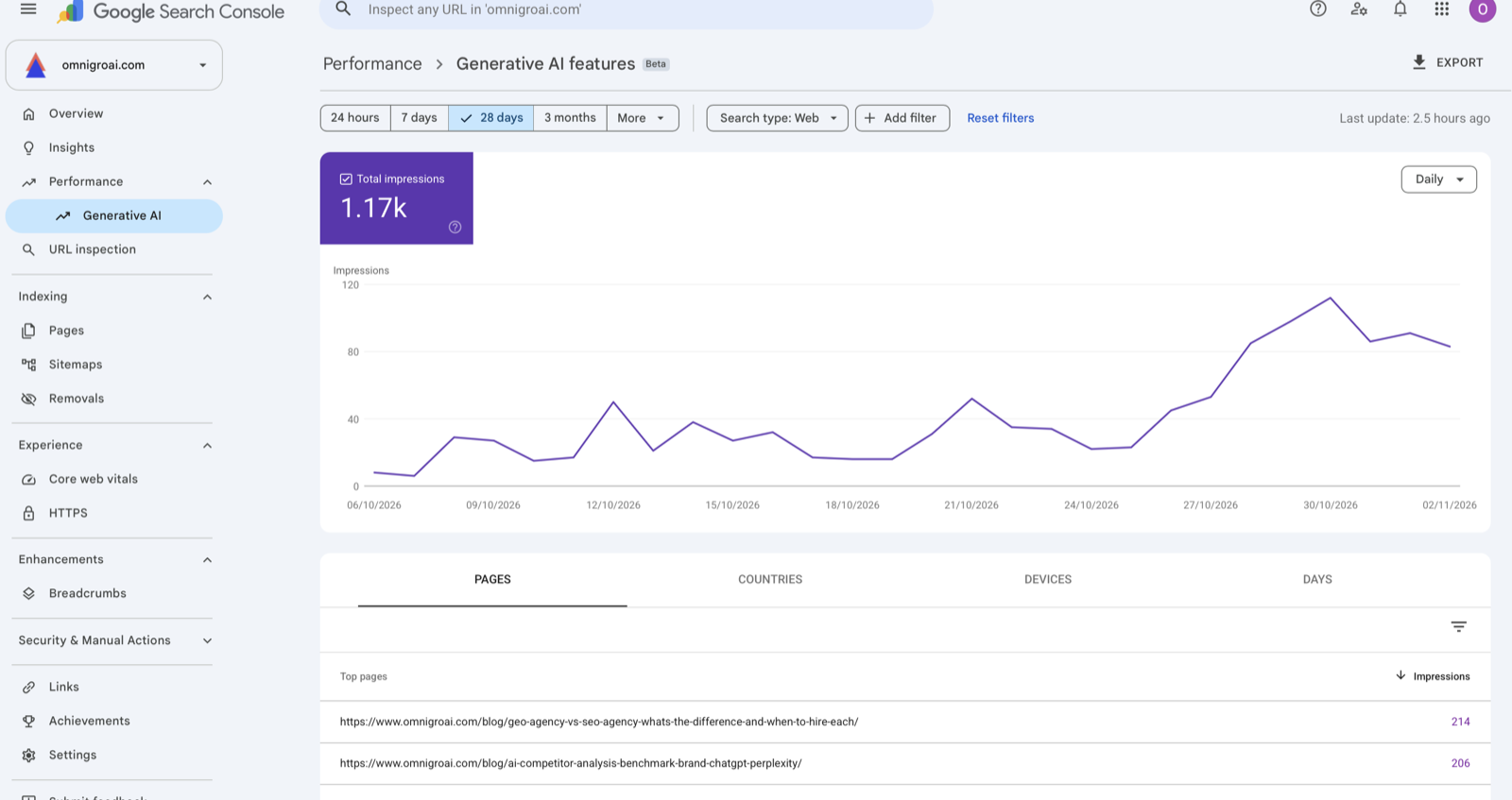
Google Search Console. The Generative AI performance report shows how often links to your site appeared in AI Overviews and AI Mode, by page, country, device and date. It counts impressions only, with no clicks and no queries, so you have to work out the prompts yourself. It had reached all websites by August 31, 2026, and it may not appear if your site has few generative AI impressions. Ours shows about 1,170 impressions in the 28 days to November 2, 2026, led by our GEO agency vs SEO agency article at 214.
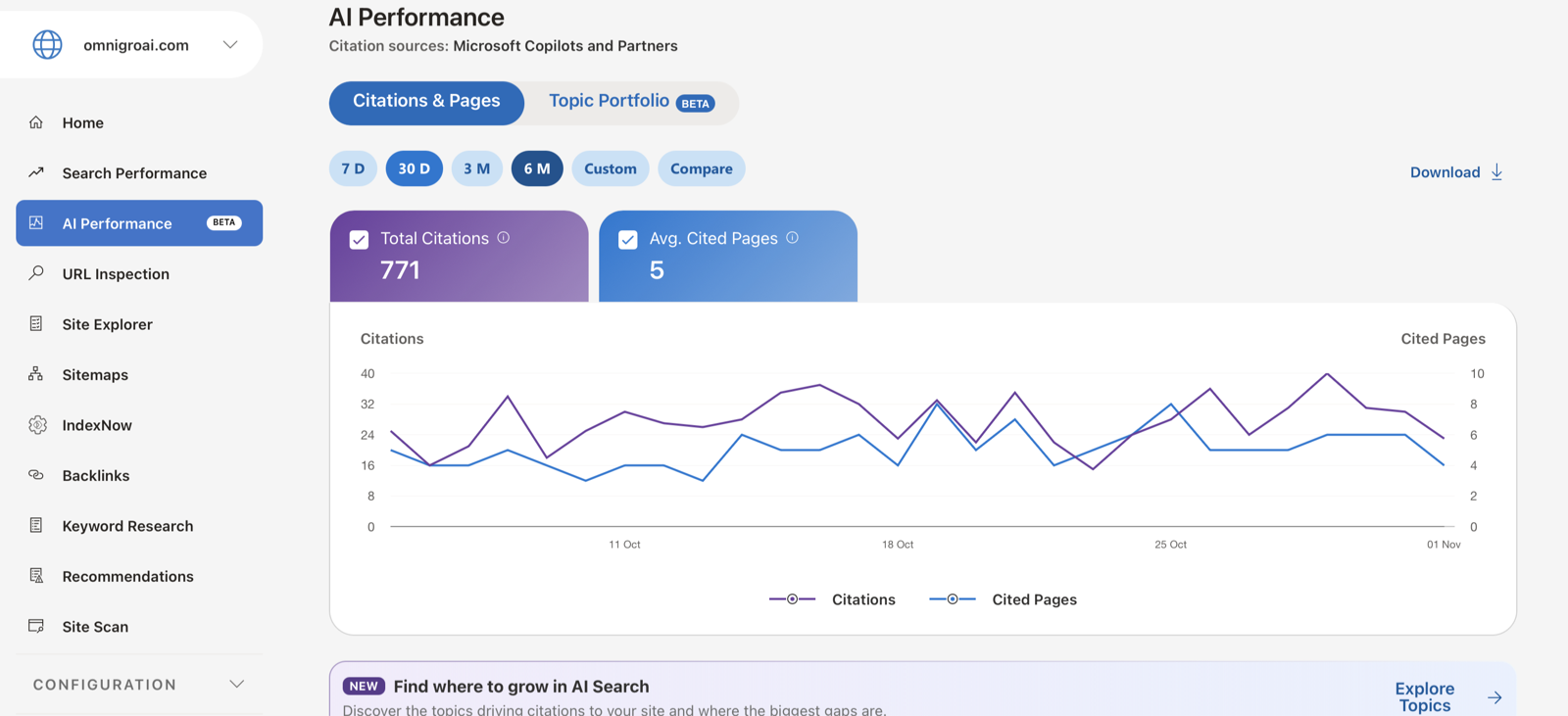
Bing Webmaster Tools. The AI Performance report launched in public preview in February 2026. It shows citations across Copilot, Bing's AI summaries and select partners, in total and per page. Ours shows 771 citations over the 30 days to November 1, 2026, from an average of 5 cited pages a day.
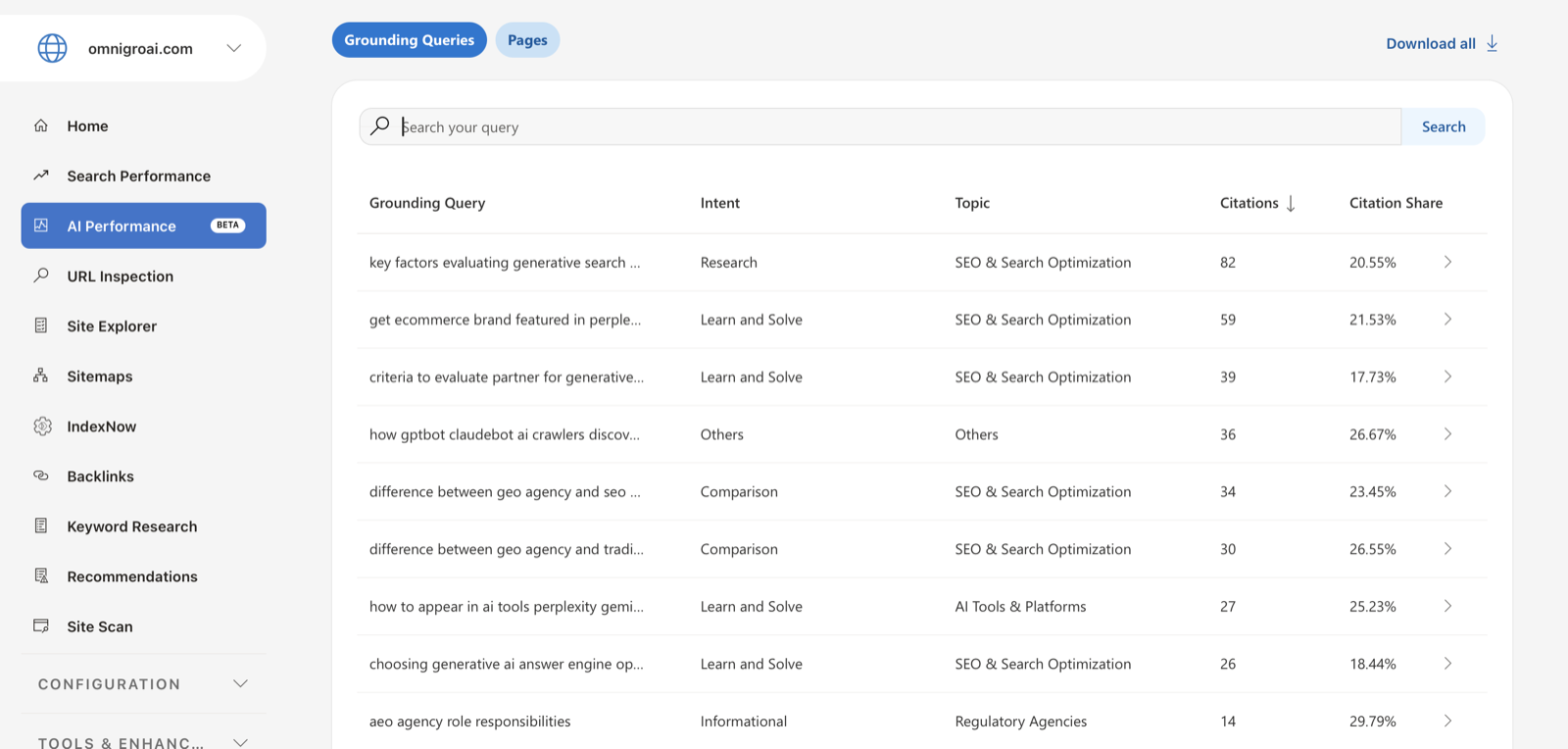
It also lists a sample of grounding queries, the phrases the AI searched before citing you. Each one has an intent, a topic and a Citation Share. Bing's Citation Share is narrower than the metric above: your percentage of all citations shown across all sites for one grounding query. It does not name the other sites, so you see your share without seeing who holds the rest. Our top query in that 30-day view earned 82 citations at a 20.55% share.
Bing warns that its labels "may still be broad", and our report shows why you should read them loosely. It files "aeo agency role responsibilities" under Regulatory Agencies.
Two gaps remain. Neither report shows whether an answer named your brand, how it described you, or which competitor it recommended. Neither names ChatGPT, Claude or Perplexity as a source, and Bing does not name its partners. We cover how these reports fit with GA4 in why your AI traffic is invisible in GA4.
How to See Your Mentions in Perplexity
You can see your Perplexity mentions in the answers themselves. Your analytics and server logs only show the visits around them. We have not found a report Perplexity offers ordinary brands that lists their mentions, so you collect this yourself or use a tracker.
In the answers. Ask your fixed prompts in a private window, so your own history is less likely to shape the result. Log two things separately: whether the answer text names your brand, and whether your domain appears in the numbered sources. You can be named on the strength of a page you don't own. In Chen et al.'s preprint, independent and community sources together made up about 91% of Perplexity's citations, for well-known and niche brands alike.
In your analytics. Filter GA4 for perplexity.ai as a session source, which counts at most the people who clicked through and kept a referrer. Use the source filter because Google's example list for the AI Assistant channel does not name Perplexity. We cover the setup in why your AI traffic is invisible in GA4.
In your server logs. Look for the Perplexity-User agent. According to Perplexity's bot documentation, it might visit a page when a user asks a question and link that page in the response. Check hits against the IP list Perplexity publishes there. A verified hit tells you Perplexity opened the page, and it does not tell you what the answer said about you. No hits does not mean no mentions, because it only fetches live some of the time.
Past a handful of prompts, you will struggle to track brand mentions in a manual log. We track Perplexity through AI Citation Tracking and pair that data with our GEO Content Engine, so you know what to create. If you would rather run it yourself, Ahrefs Brand Radar and Semrush's AI Visibility Toolkit both cover Perplexity. To raise those mentions, see how to get your brand mentioned in Perplexity.
How to Benchmark Your AI Citations Against Competitors
Run your unbranded prompts more than once, note every brand named in each answer, and compare how often each one appears. Leave out brand-direct and comparison prompts, because they name you by design. You don't need separate runs for your rivals, because each unbranded answer already shows who was named alongside you. We cover the full method, including how to map sources into a gap list, in our AI competitor analysis guide.
Here is what a benchmark looks like over time. For one gym we work with, we tracked 47 unbranded questions against 8 competing gyms on ChatGPT and Gemini. The share of answers naming it went from 5.6% in July to 24.5% in October. On a 30-day average, it moved from 9th to 1st among the 9 gyms.
Keep each benchmark inside one method. Semrush's share figure is based on mentions, while Ahrefs' is weighted by the search volume of each prompt, so you can't compare the two. We run this comparison against your named competitors through Competitor AI Intelligence.
What to Do When a Citation Is Missing or Wrong
A missing citation on a brand-direct prompt usually traces back to what the model can read, rather than what it thinks of you. Check whether your own pages are reachable in raw HTML, since most AI crawlers don't execute JavaScript the way a browser does. We cover this mechanism, and the JavaScript-rendering gap behind it, in why your brand ranks on Google but not in ChatGPT or Perplexity.
A wrong citation, meaning the model states something inaccurate about your brand, usually traces back to conflicting sources. When your site, directory listings, and review platforms disagree, the model hedges. Or it repeats whichever source it trusts most, even when that source is wrong, or drops you for a competitor with a consistent story. We reconcile those sources, starting with the ones the engines cite most, through Entity Consistency Monitoring.
A missing citation on a category prompt, or a comparison answer that only cites your rival's coverage, usually points to a gap in independent coverage. According to Chen et al.'s unreviewed preprint, earned third-party sources make up between 63% and 95% of citations across the major models. That range shifts with the engine and how well-known the brand is. Earned sources means independent media, reviews, and comparison sites. A brand with strong owned content but no outside coverage is likely to keep losing that slice.
FAQs
What counts as an AI citation?
An AI citation is any instance where a model names your brand or links to your domain while answering a real buyer question. That covers a cited source or a recommended option. A generic category mention with no brand name attached doesn't count.
Is being cited the same as being recommended?
No. A brand can be quoted as a source on a topic and still lose the sale to a named competitor in the same answer. Track both. A citation gap without a recommendation gap usually means a technical or entity fix; the reverse usually means thin product evidence.
How often should I run an AI citation tracking check?
At least monthly, on the same prompt set every time. According to SISTRIX, 56% of the domains AI Mode cites for a prompt in an average week weren't there the week before. A one-time check only shows what was true that day.
Can I track AI citations without paying for a tool?
Yes. Google Search Console and Bing Webmaster Tools both report AI activity on your own pages for free. To see what answers say about you, run your prompt set through each model's own interface and log the results by hand. It works at a small scale and becomes unmanageable once you're tracking more than a handful of prompts across four engines every month.
Why would a citation disappear even if nothing on my site changed?
The sources an AI model retrieves from can change even when yours doesn't. A directory update or a competitor's new comparison page can move a citation without any action on your part.
The Bottom Line
Start by writing your fixed prompt set and running it in each engine, logging every named mention and source link. That first log shows you which fix above comes first, and the next run shows you when a competitor takes an answer. Our own AI Citation Tracking runs thousands of buying-intent prompts across each major LLM every week. It records which brands appear, in what context, and with what sentiment. Get a free AI visibility assessment to see where your citations stand on ChatGPT and Gemini today.