How Three Squared Nine Became the #1 AI-Recommended Fractional Legal Provider in Singapore
Between April and June 2026, OmniGro ran a pilot program for Three Squared Nine, a fractional legal counsel provider in Singapore. The brand started absent from AI answers and mostly missing from search indexes. By the end, it was the first provider recommended across ChatGPT, Gemini, Google AI, and Perplexity for its core Singapore queries. Organic clicks grew 451% and search impressions grew 2,778%. From only 20% of pages indexed on Google and no indexing on Bing, the site is now fully indexed on both. No backlinks were added.
Data from GSC, GA4, Bing Webmaster Tools, and OmniGro's AI visibility tracker.
On ChatGPT, Gemini, Claude, and Perplexity
Organic clicks growth
Search impressions growth
Avg AI visibility score across all platforms
Results at a glance
Three Squared Nine went from invisible in AI answers to the first provider named for its niche, and from mostly unindexed to ranking across dozens of pages.
| Metric | Before | After | Source |
|---|---|---|---|
| AI recommendation rank (core niche queries) | No presence | #1 across 4 models | OmniGro's AI visibility tracker |
| Recommendation in high-intent prompts | 4 of 15 | 15 of 15 | OmniGro's AI visibility tracker |
| Organic search clicks | 65 | 358 | Google Search Console |
| Search impressions | 848 | 24,400 | Google Search Console |
| Pages indexed by Google | 8 | ALL | Google Search Console |
| Pages indexed by Bing | 0 | ALL | Bing Webmaster Tools |
| Singapore share of clicks | n/a | 71% (253 of 358) | Google Search Console |
| Backlinks added | 0 | 0 | Bing Webmaster Tools, GSC |
“OmniGro found problems on our site that normal web work had missed, from broken schema to pages search engines could not even read. They fixed every one of them and explained the why at each step. We trusted them with the detail, and the results were far better than we ever thought possible for a new company of our size.”
Jess, Three Squared Nine
Who Three Squared Nine is
Three Squared Nine provides fractional, embedded legal counsel and compliance support to startups, SMEs, and growth-stage companies in Singapore. It competes for these queries against alternative legal providers many times its size, such as Axiom and Legal.io. In fractional legal counsel for the Singapore market, size does not decide which provider an AI recommends, which is why a focused provider can rank ahead of larger incumbents.
Where they started: invisible and mostly unindexed
At the project start on April 13, Three Squared Nine was close to invisible in both AI answers and search. According to the April 21 AI visibility tracker reading, the brand had no presence on 11 of 15 tracked unbranded discovery queries. Search was worse: 8 pages were indexed by Google, around 80% of existing pages were not indexed at all, and the homepage drew 94% of all search clicks because almost no other page ranked.
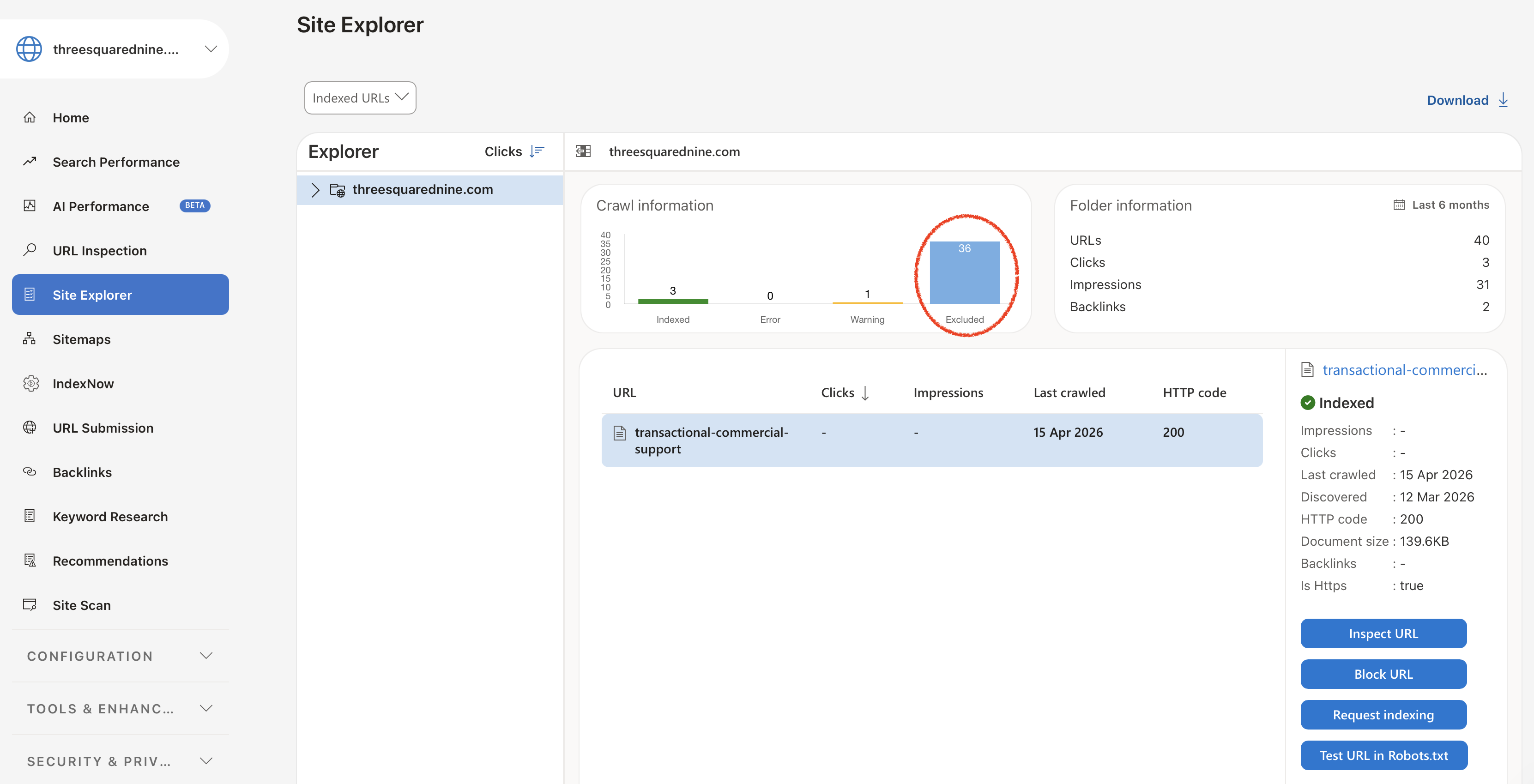
The bigger problem sat with Bing. The site had only 3 outdated pages indexed months ago, with 40 known URLs mostly marked excluded and 2 backlinks. Fixing Bing indexing was high on our priority list because of its connection to ChatGPT (more on this later).
The in-depth audit
OmniGro ran a full GEO, AEO, and SEO program in-house. An in-depth audit found the issues, and OmniGro fixed every one, down to the small technical signals most agencies leave alone. The work split into indexing, technical cleanup, content, and continuous monitoring.
Indexing: cleaning the signals so crawlers trust the pages
Multiple pages carried wrong or duplicated meta titles, descriptions, and schema. Service pages, for example, had Article schema with the same title repeated on every page, a RankMath misconfiguration. OmniGro rewrote every page's meta data, applied the correct schema per page type, then triggered reindexing. Clean, distinct metadata plus correct schema tells Google and AI crawlers that each page is useful, distinct, and crawlable, which is why around 80% of previously unindexed pages began to index.
The Bing blackout, and why it mattered for ChatGPT
The hardest fix was Bing, where the site had no fresh indexed pages. OmniGro submitted through IndexNow first, which returned nothing. It took a month of repeated submission and signal cleanup before pages started to index. A support ticket to Bing returned only “your site does not follow Bing Webmaster Guidelines,” with no detail, so OmniGro worked the signals collectively: schema, metadata, sitemaps, and resubmission. Getting indexed on Bing matters beyond Bing itself. According to GeekWire, Bing became ChatGPT's default search engine, so a site missing from Bing's index is hard for ChatGPT to surface from the live web.
Content: 28 new pages built for AI extraction
OmniGro published 28 new publication pages and 2 new site pages, all targeting the brand's core legal and compliance queries. Every page ran through OmniGro's GEO Content Engine, a rigorous 15-step pipeline with 2 human checkpoints. The pages use the answer-first structure described in GEO content engineering, which leads each section with the direct, citable answer that AI models extract from.
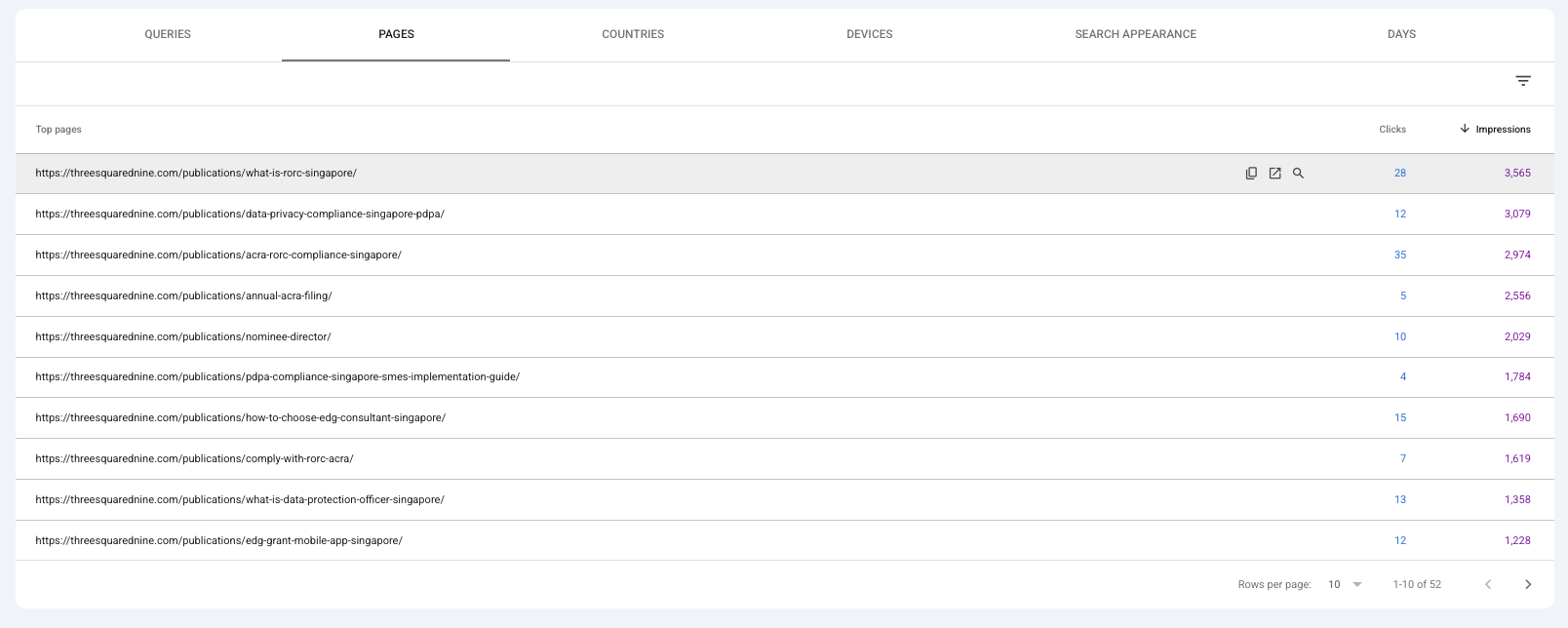
The output surprised our own team. Some articles pulled between 2,000 and 3,500 impressions within their first week of publishing, and most landed inside the top 5 search results (see top pages). This rarely happens for a site with a domain authority this low.
Technical cleanup: removing dead code that confused crawlers
The WordPress theme left dead code on the pages. A couple of hidden template widgets carried a wrong phone number, and several pages had hidden incorrect text and empty H1 tags. None of it was visible to users, but crawlers still read it, which confused them and polluted the brand's entity consistency. OmniGro removed it and corrected the heading structure, work that supports the entity consistency AI engines rely on. The same blind spot affects any site with content hidden in markup, as covered in why accordions hide content from AI crawlers.
Monitoring: hundreds of prompt checks, not a spot check
OmniGro tracked progress with continuous AI monitoring rather than occasional manual checks. The monitoring ran hundreds of prompt checks across ChatGPT, Perplexity, Google AI, Gemini, Copilot, and Grok, recording every brand mention and the sources each answer drew from.

From invisible to recommended: the AI queries
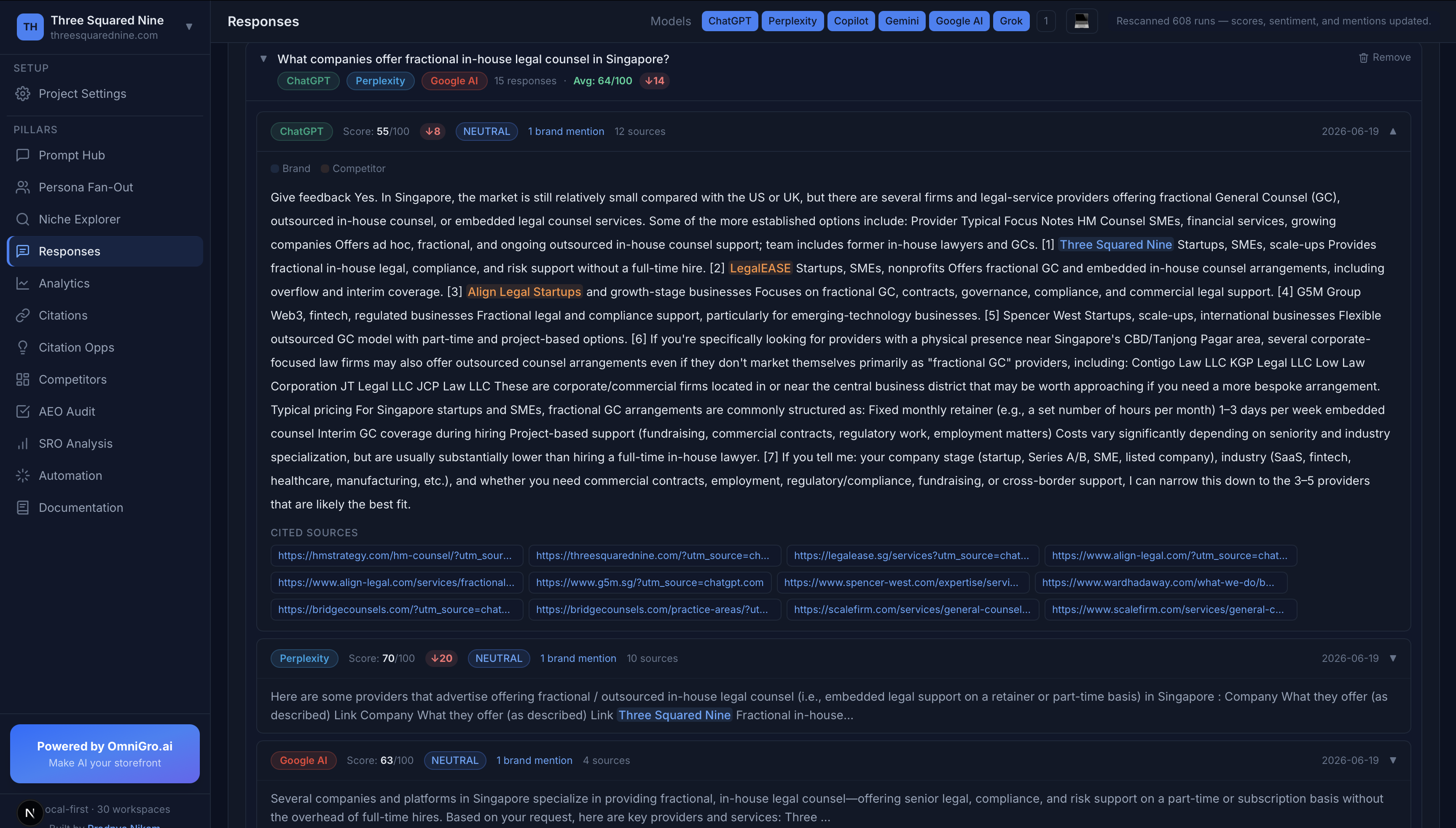
By June 19, Three Squared Nine appeared on all 15 tracked unbranded query rows, up from 4 in April.
How the visibility score is calculated
Each AI response scores out of 100 across four dimensions: brand mention presence (40 pts), position and prominence (30 pts), sentiment (20 pts), and context quality (10 pts). The percentages in the table below are the combined score for that prompt and platform on that date. A higher number means the brand appears earlier, more positively, and in a more accurate context. For a full walkthrough, see what's inside an OmniGro AI visibility assessment.
Unbranded discovery queries
Unbranded queries name no brand, so visibility means the AI engine recommends Three Squared Nine on its own. According to the AI visibility tracker readings, the brand was absent from 11 of these query and platform rows in April and present on all of them in June.
| Prompt | Platform | April 21 | June 19 |
|---|---|---|---|
| Fractional in-house legal counsel in Singapore | Google AI | 61% (negative) | 66% (positive) |
| Fractional in-house legal counsel in Singapore | ChatGPT | 32% | 58% |
| Fractional in-house legal counsel in Singapore | Perplexity | No presence | 69% |
| Fractional in-house compliance support in Singapore | Google AI | 55% | 73% |
| Ongoing compliance support without a full-time officer | Google AI | No presence | 74% |
| Corporate compliance training in Singapore | Google AI | 63% | 67% |
| Build risk management frameworks in Singapore | Google AI | No presence | 52% |
The core “fractional in-house legal counsel” query on Google AI moved from a negative result to a positive one, which means the engine changed how it described the brand, not just whether it mentioned it.
The AI engines now cite the brand's own articles
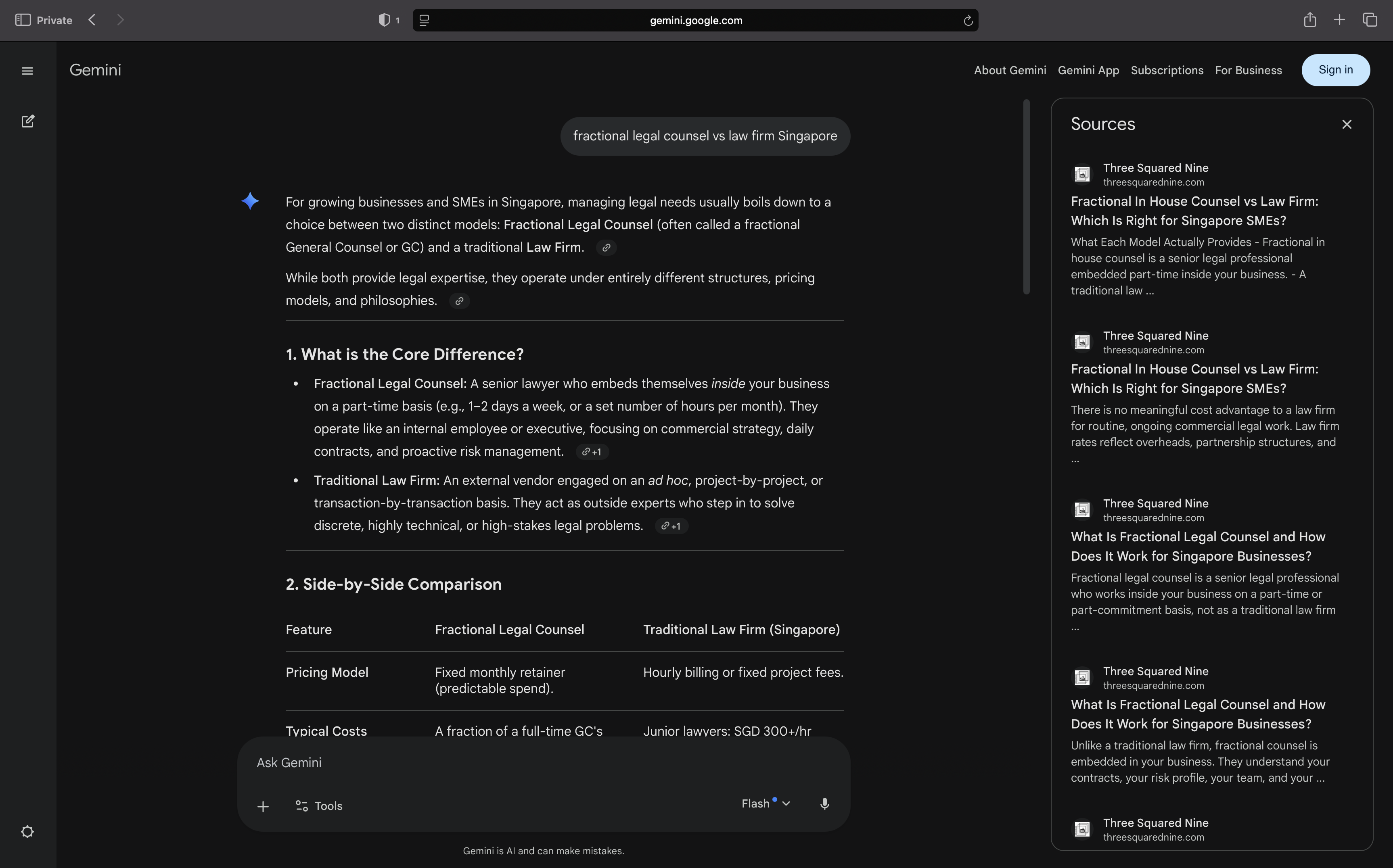
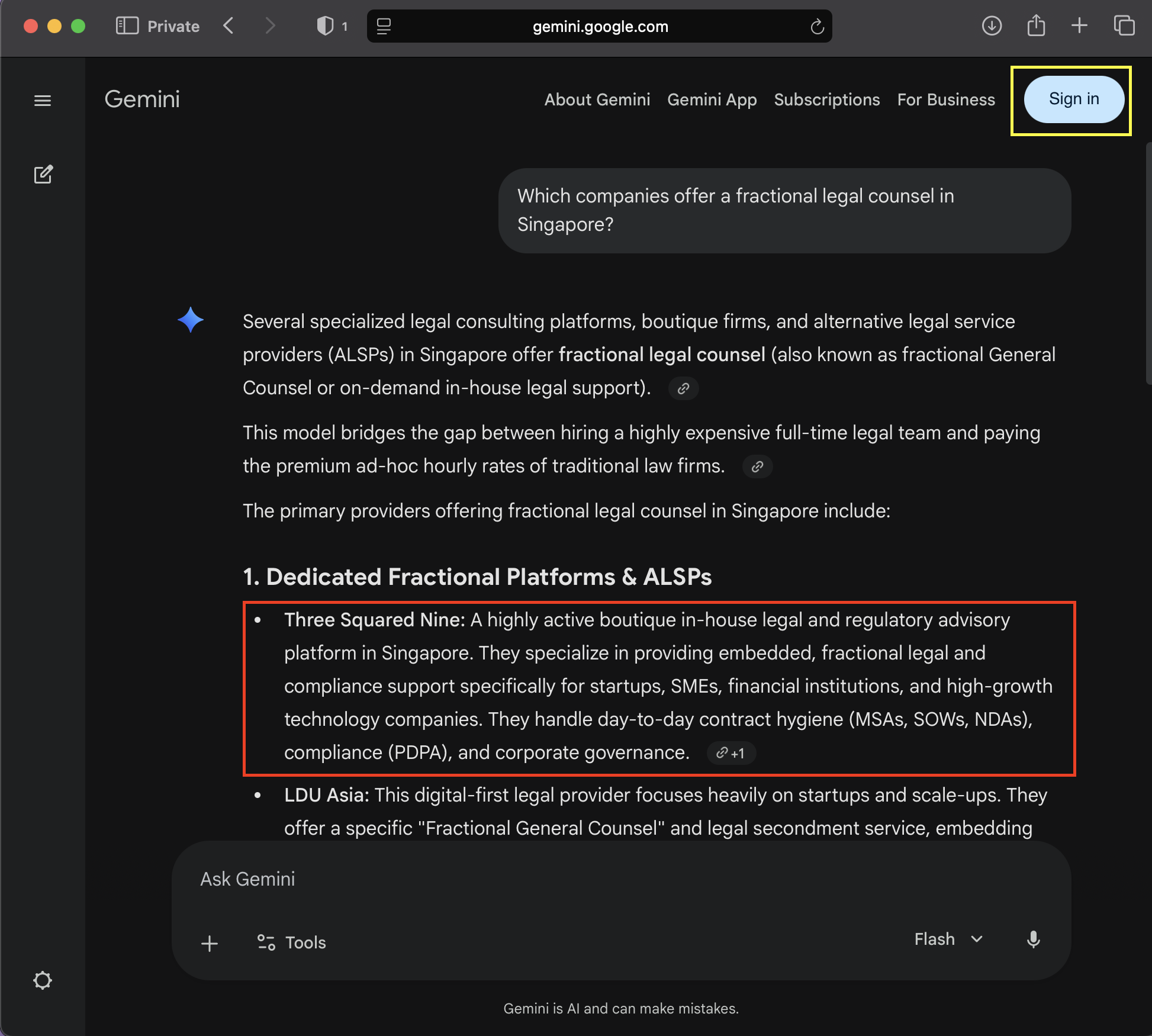
The visibility comes from AI engines reading and citing the publication pages OmniGro built, which is what establishes credibility with the models. For a “fractional legal counsel vs law firm” question, Gemini built its answer from five Three Squared Nine articles, and Perplexity pulled them as top sources.
It also gives us confidence that the GEO Content Engine produces articles with a higher chance of being cited.
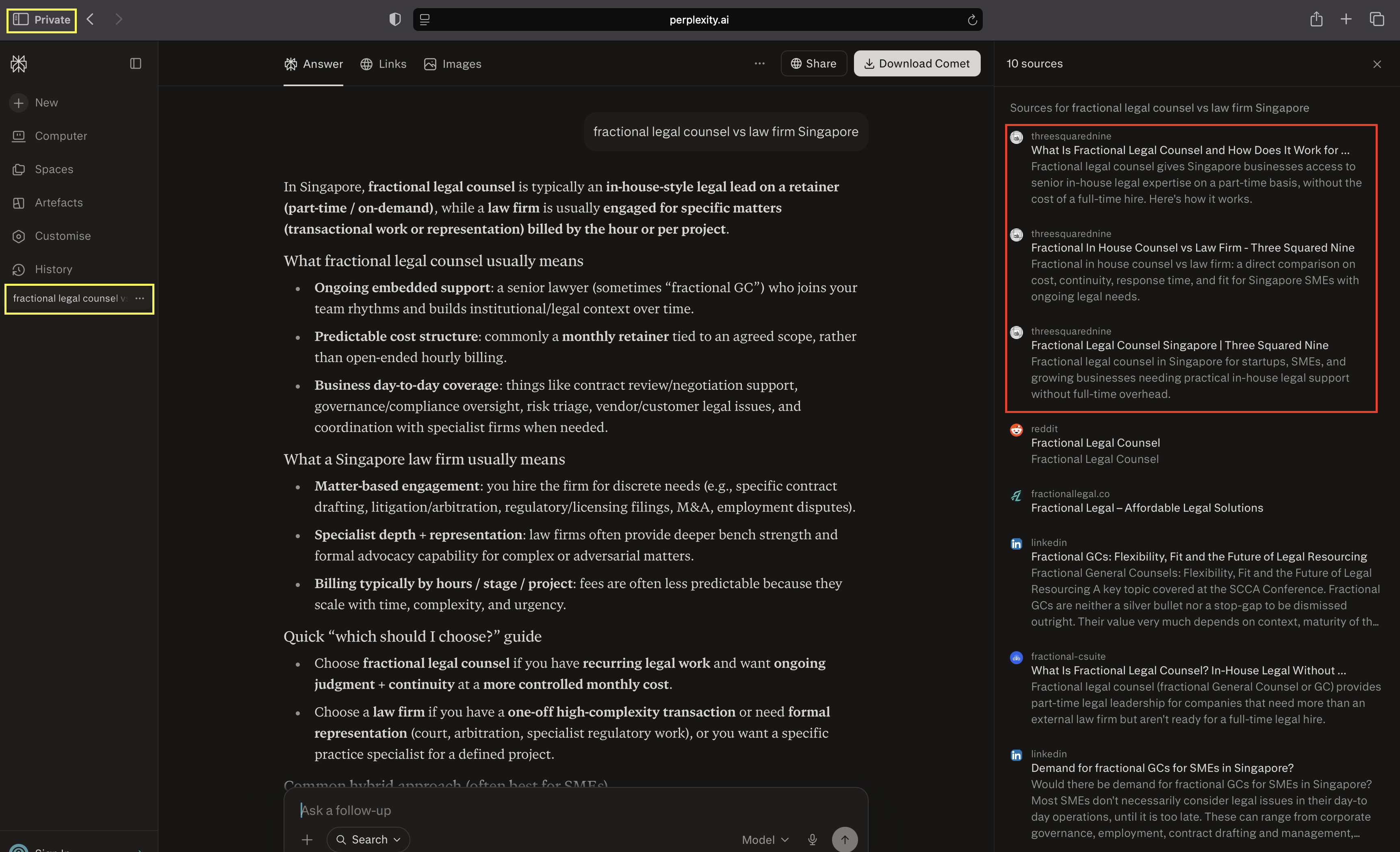
See it yourself: incognito results
Every result below was captured in incognito, private, or signed-out mode, so no account history influenced the answer. This is what a prospect with no prior browsing sees when they ask an AI for a recommendation.
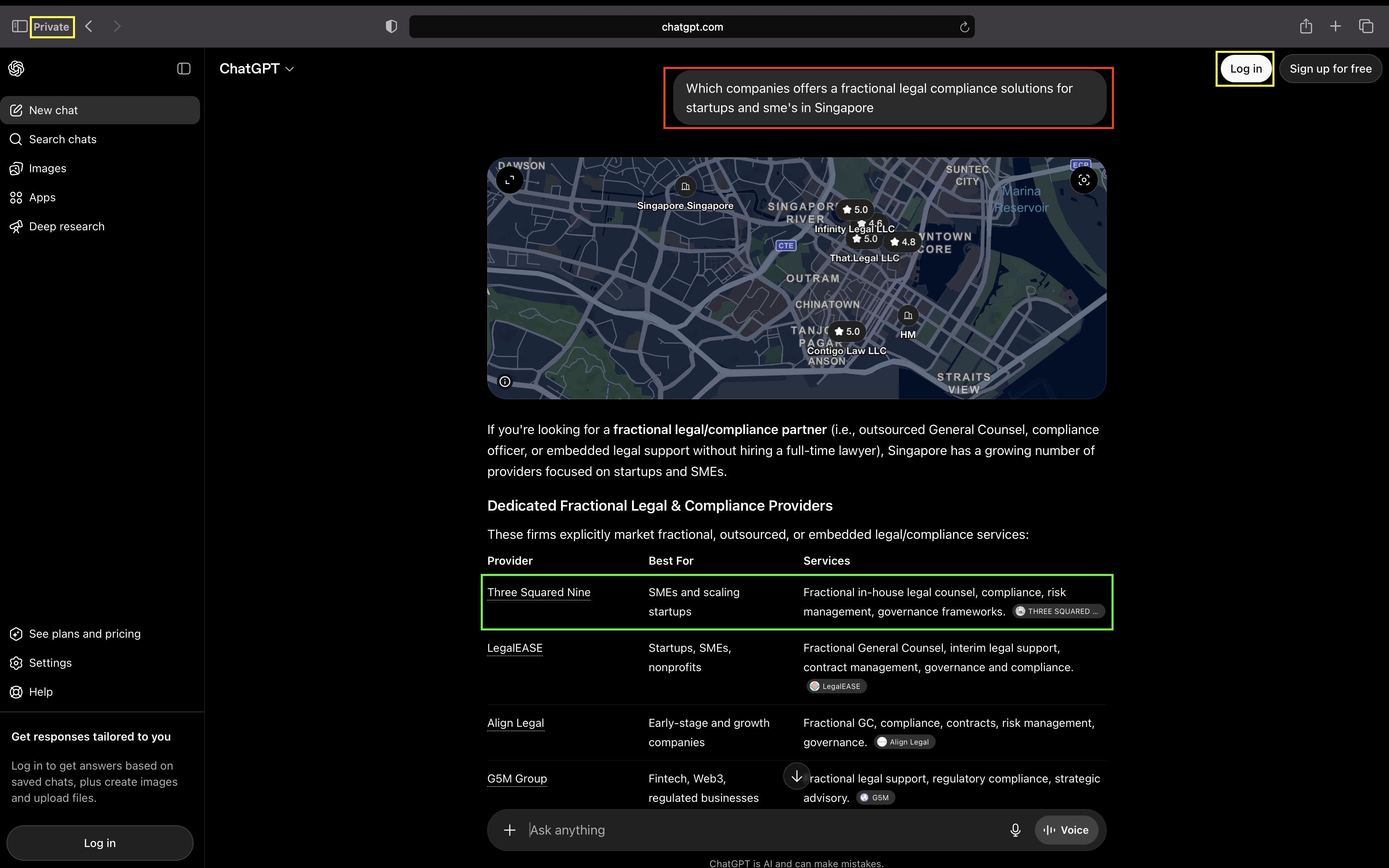
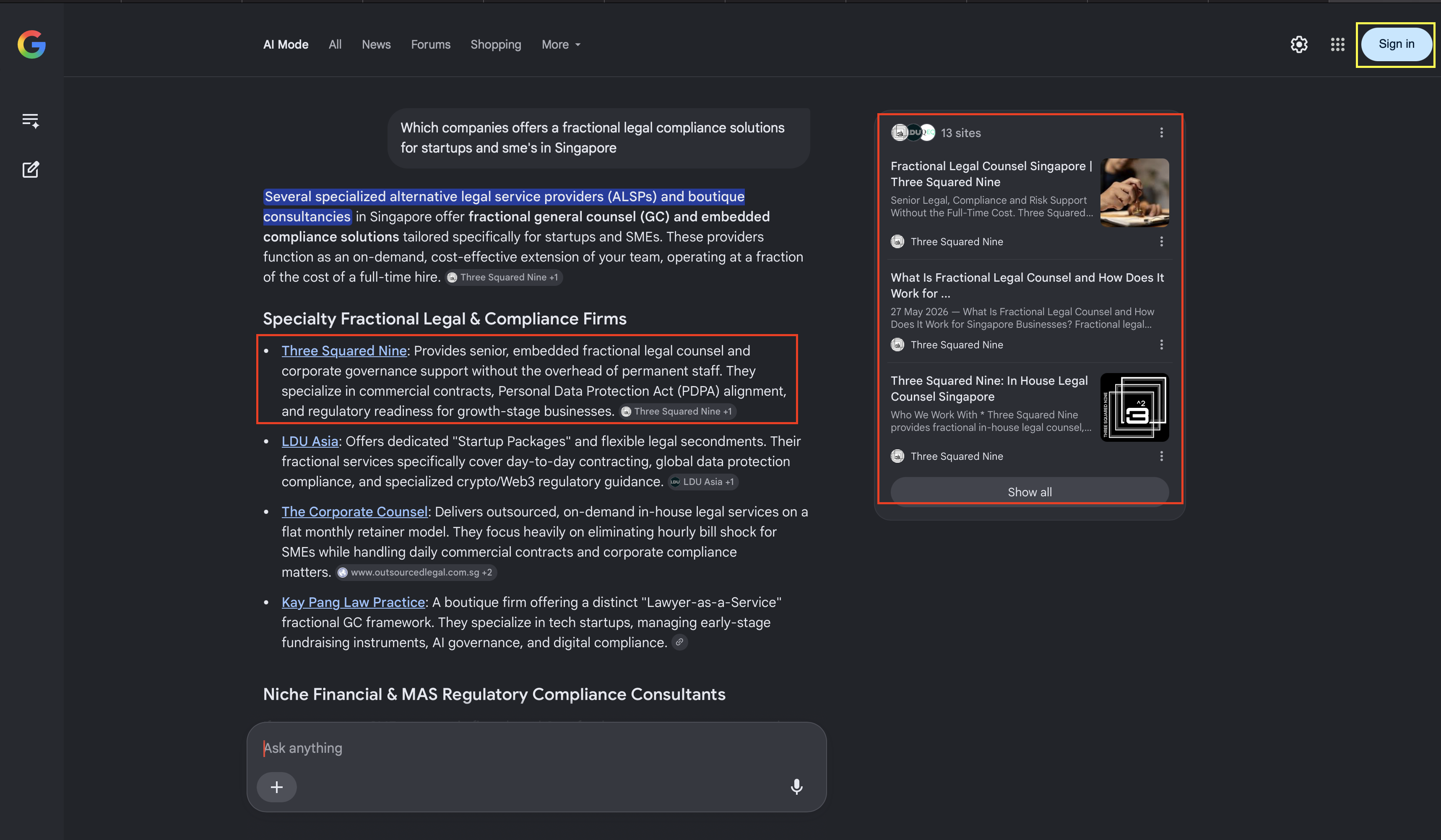
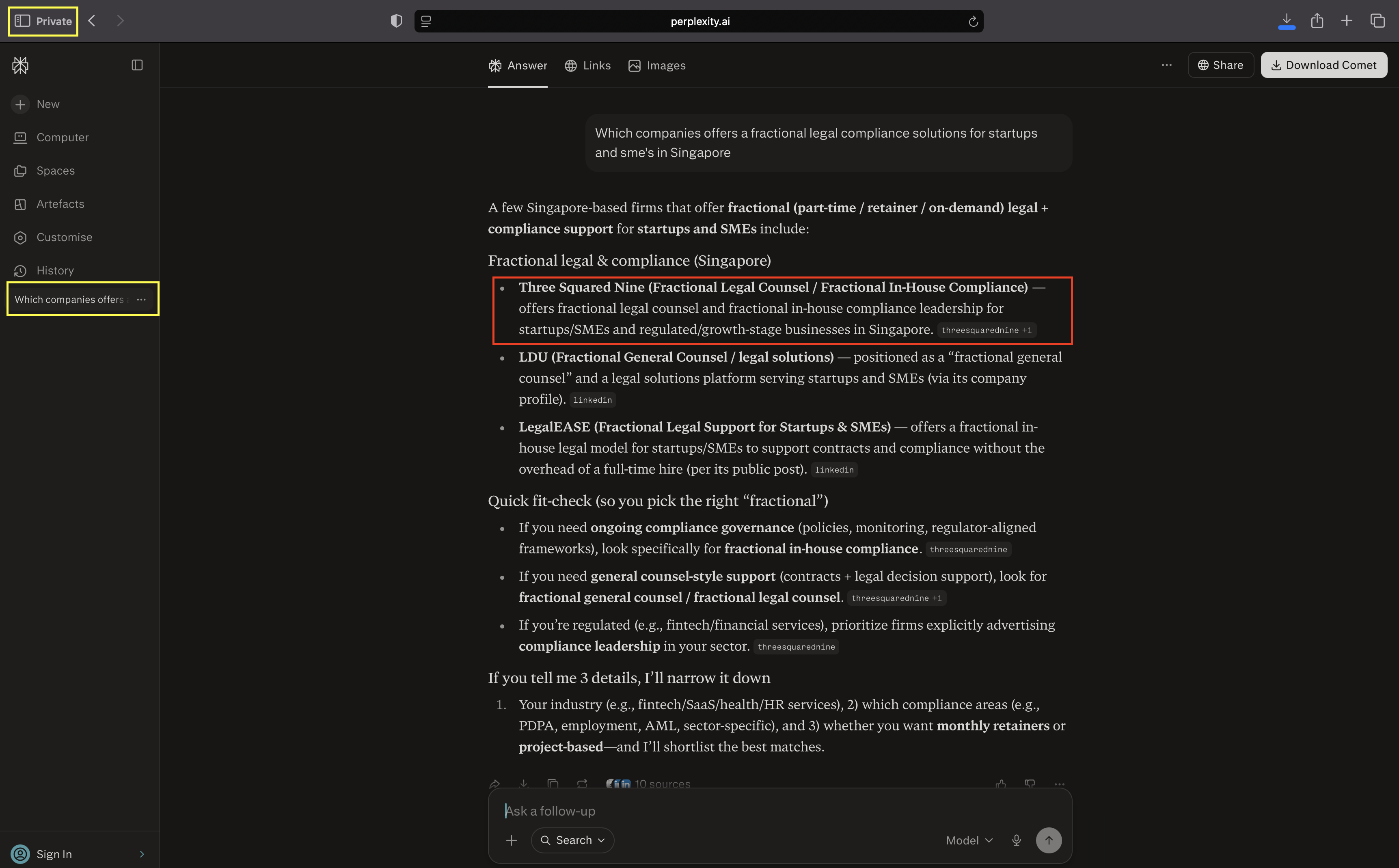
Where the traffic comes from
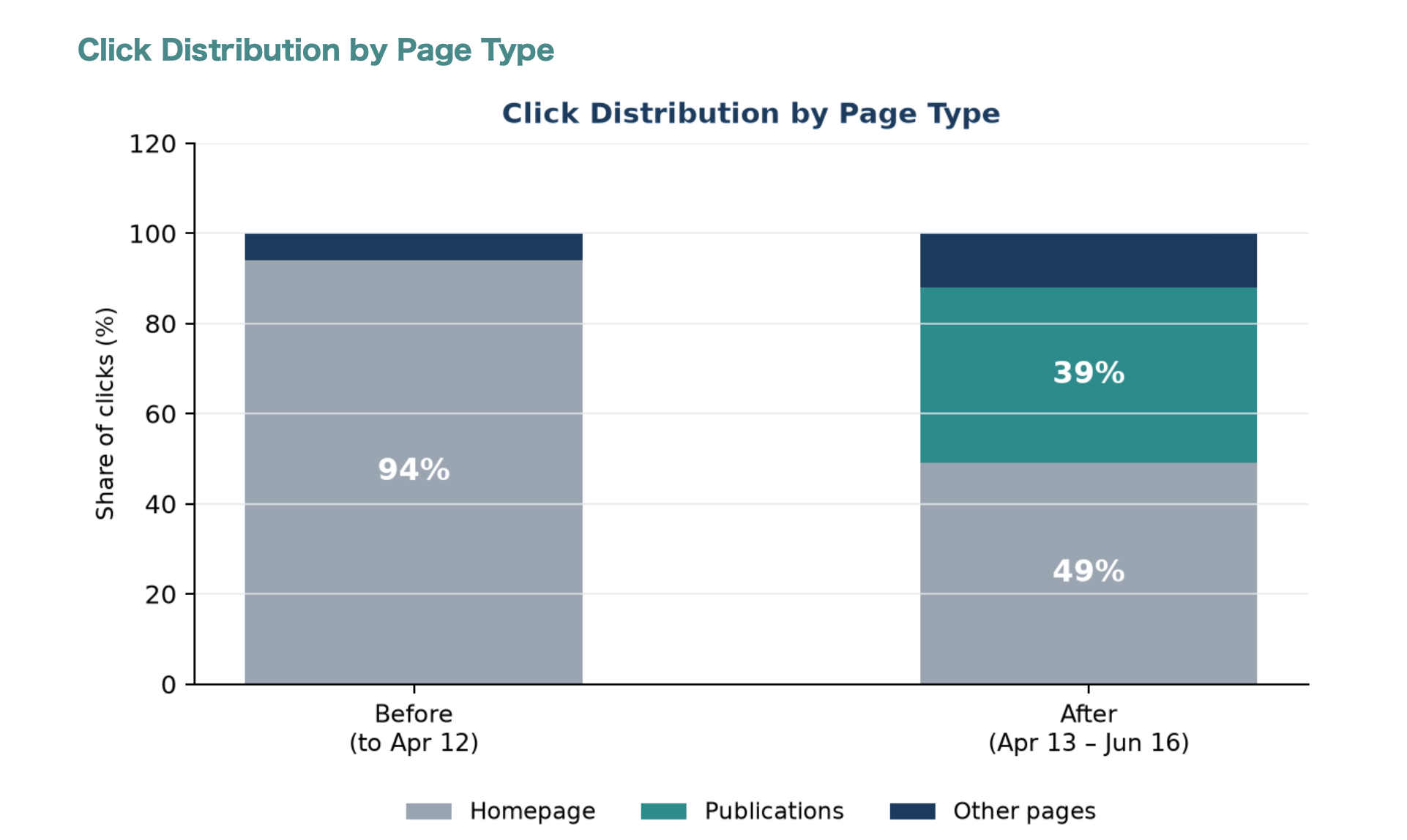
The search growth came from the right audience, not from volume noise. According to Google Search Console, Singapore accounts for 71% of clicks (253 of 358). The branded query “three squared nine” sits at position 1 with a 55% click-through rate. The homepage's share of clicks fell from 94% to 49% as publication pages took 39%, which means the site now earns rankings across the publication and service pages, not only the homepage.
What it did for the business
We are not at liberty to share commercial figures for our client. What we can say is that demand has grown, and the team is now hiring to keep up with the workload.
Why these results hold up
The gains are structural, not the result of off-platform networking or one-off referrals. No backlinks were added during the pilot, and the profile stayed at the 2 backlinks recorded at the start, so every gain traces back to OmniGro's on-site content and technical work. The indexing jump came directly from new pages plus the metadata, schema, and reindexing fixes, and the publication clicks came from pages that did not exist before.
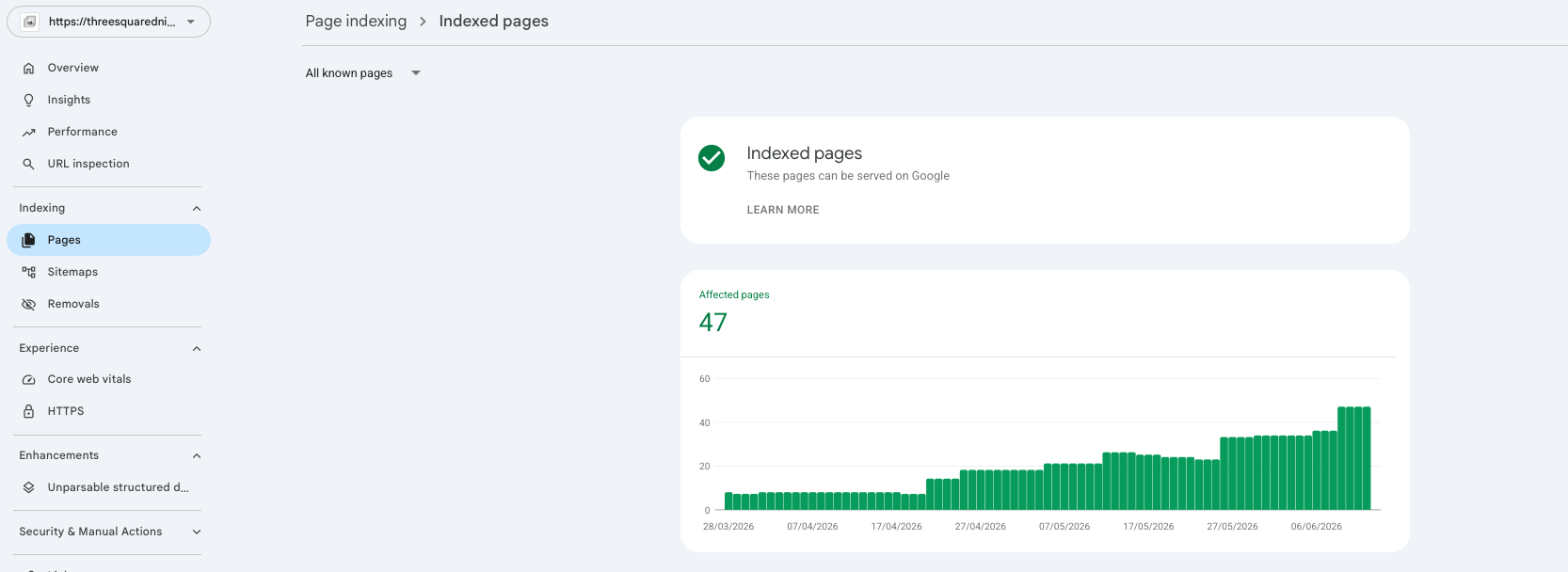
According to Google Search Console, indexed pages were flat at 8 from March 21 through April 20. They then began climbing on April 21, kept rising through May, and by June 9 the full site was indexed, tracking the publishing and technical work. The AI visibility changes appear in two independent AI visibility tracker readings, dated April 21 and June 19, using the same prompts and scoring method. Live incognito tests on five platforms confirmed the #1 placements separately.
Repeatable across industries, custom per brand
The work behind these results is structural. It applies to any brand competing for AI recommendations in a defined niche. What changes per brand: the prompt set, the content angles, the entities AI needs to learn, the citation style each industry rewards, and the technical fixes a specific stack demands. What stays the same: answer-first content, schema and entity consistency, crawler access, and continuous prompt tracking.
This method is not bound to expertise-led services. It works for ecommerce brands competing on product recommendations, SaaS companies competing on category questions, and consumer brands competing on intent-driven discovery. The proof on this page is one pilot because we publish only what we can verify, not because the playbook is narrower than that.
Every engagement starts with a custom strategy. We map your prompt set, audit how AI engines describe your brand today, and benchmark the sources AI currently cites in your category, the format of those citations, and what earns them. The content, schema, and technical plan are built around those findings. Two brands in the same vertical get different plans because their entity footprint, crawler access, citation profile, and competitive set differ.
What is next
The pilot won the core niche queries, and the next phase targets the broader ones. On generic prompts like “best regulatory compliance advisory firms in Singapore,” the brand is not yet the recommended answer on every engine. The broader queries should follow the same pattern as the niche queries: each new indexed and cited page widens the surface AI engines draw from. That is the focus of the next cycle. For the method behind this, see the GEO 2026 guide.
FAQs
Were any backlinks added during the pilot?
No. The backlink profile stayed at 2 backlinks throughout, so every gain traces back to OmniGro's on-site content and technical work rather than new off-site links.
Why did indexing take time, and what about Bing?
The site was unindexed on Bing and mostly unindexed on Google. IndexNow alone did nothing, so it took a month of metadata fixes, correct schema, and repeated resubmission before pages indexed. Bing matters because ChatGPT's web search has relied on Bing's index.
Did AI visibility come at the expense of Google search traffic?
No. Organic clicks rose from 65 to 358 over the pilot, and the same-length period-over-period view in Search Console shows clicks up 93% and impressions up 98%.
Is this method only for legal and consulting firms?
No. The same method applies to ecommerce, SaaS, healthcare, financial services, and any brand competing for AI recommendations in a defined niche. What changes per brand is the prompt set, the content angles, the entities AI needs to learn, the citation style each industry rewards, and the technical fixes a specific stack demands. What stays the same is answer-first content, schema and entity consistency, crawler access, and continuous prompt tracking. Every engagement starts with a custom strategy: we benchmark how AI currently cites in your category, the format of those citations, and what earns them, then position the brand to get cited the same way.
Are the AI rankings repeatable, or a one-time snapshot?
AI responses are non-deterministic by design. To handle this, we track core prompts on a periodic schedule (daily or every 6 hours) using OmniGro's AI visibility tracker. The tracker averages out one-off answers, so what we report is the visibility needle moving, not a single lucky result.
See where your brand stands today
Three Squared Nine started invisible across AI and barely indexed in search. The pilot closed with structural visibility across four AI engines, a fully indexed site on Google and Bing, and a publishing footprint earning rankings of its own. The same playbook is repeatable for any brand willing to invest in the work behind it.
Request a Brand Visibility Audit