
There's no special trick to Google AI Overviews SEO or Google AI Mode SEO, according to Google's own documentation. Google says its AI features "are rooted in our core Search ranking and quality systems," so the same SEO basics apply. A top-10 ranking helps, but it no longer decides the citation on its own. The two surfaces often cite different sources. According to SISTRIX, they cited different domains for the same prompt 83% of the time.
What Decides Inclusion in AI Overviews and AI Mode
SEO best practices still apply because, according to Google's AI optimization guide, its AI features "are rooted in our core Search ranking and quality systems." Technical eligibility comes first.
Your content has to be crawlable, indexed, eligible for a snippet, and not excluded from Search generative AI features in Search Console. Sites are included by default. Google states plainly that its "generative AI models use publicly accessible, crawlable content."
Google renders JavaScript, so a client-side site can still reach AI Overviews. ChatGPT, Claude and Perplexity's crawlers don't render it, though. If your content only appears after JavaScript runs, see how AI crawlers read your site before you assume Google's result carries over to them.
Google also wants content that isn't already available elsewhere. The same guide asks writers to "create the content yourself based on what you know about the topic." It calls the goal "non-commodity content that's helpful, reliable, and people-first." A page that restates what already ranks has nothing for the AI system to prefer it over the original.
Google's AI features page states there's no special schema.org structured data you need to add. Google's optimization guide adds that you don't need to write in a specific way for generative AI search. Markup helps a machine confirm what you have already said in your own words.
How AI Overviews and AI Mode Actually Differ
Both features may use query fan-out. That means breaking a question into several related sub-searches and pulling supporting pages for each, then synthesizing the results into one answer. Google's own AI features page says the two "may use different models and techniques, so the set of responses and links they show will vary."
SISTRIX's 17-week study measured how far that variation goes. AI Overviews and AI Mode cited different domains for the same prompt 83% of the time. So you need to check each surface separately, since being cited in one doesn't guarantee the other.
Reach differs too. According to Google's I/O 2026 announcement, AI Mode "surpassed one billion monthly users" within a year of launch. AI Mode queries have more than doubled every quarter since launch, according to Google. Read the full I/O 2026 search roundup for what else changed alongside it.
Ranking Well on Google Doesn't Guarantee a Citation
According to Ahrefs' March 2026 update, only 37.9% of URLs cited in AI Overviews also appeared in Google's top 10 results. That's down from about 76% when Ahrefs first measured it in July 2025. Ahrefs suggests Gemini 3's broader query fan-out is pulling from more sources. It also notes it improved its own citation parsing between the two studies.
So most AI Overview citations now come from pages outside Google's top 10. Why your brand ranks on Google but doesn't appear in ChatGPT or Perplexity covers the same disconnect for other engines.
What a First-Place AI Overview Citation Looks Like
A first-place citation means the AI Overview names your brand first in its own list, for a question that never mentions you. It also cites your pages as its sources. Horizon Wellness Club, a gym in Singapore's CBD, reached that position after nine weeks of GEO, AEO and SEO work. Google's AI Overview now lists it first, with Horizon pages as the first source cited and two of the three shown.
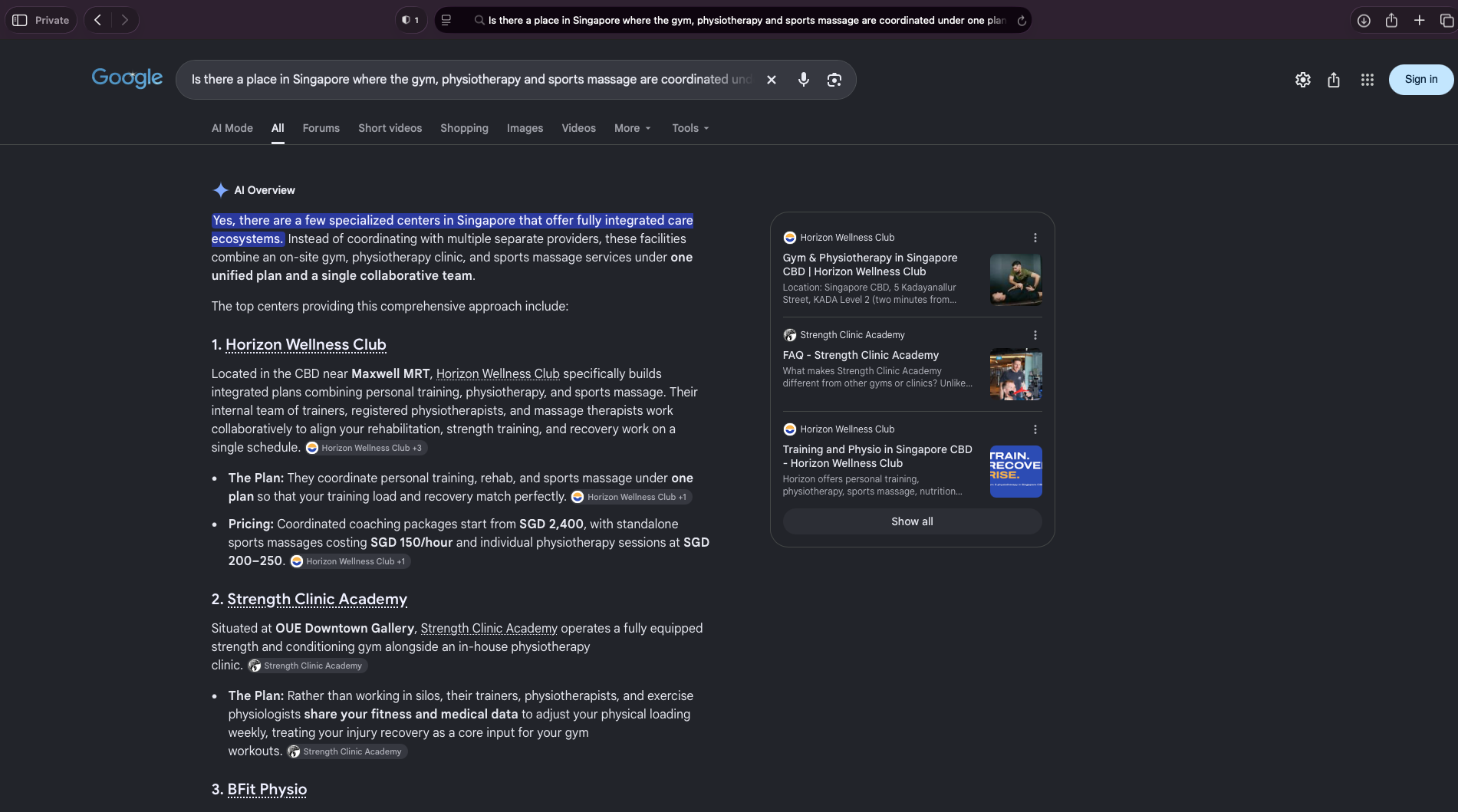
The question asked for a place in Singapore where a gym, physiotherapy and sports massage run under one plan. It was asked in a private browser window with no account signed in. In that round of live tests, Horizon was the first recommendation in 5 of 8 Google AI Overview answers. Across ChatGPT, Gemini and AI Overviews together, it was first in 14 of 18. Its weekly impressions in AI Overviews and AI Mode grew 7.5x over the same period. The full method and every screenshot are in the Horizon Wellness Club case study.
Preferred Sources: Helping Readers Choose You
On May 27, 2026, Google brought Preferred Sources into AI Overviews and AI Mode. Readers already used the feature in Top Stories. A reader picks the sites they trust in their Search personalization settings. From then on, Google can badge your links as "Preferred" in AI answers that reader sees.
You can't add yourself, but you can make it easy for readers. Google states that "any website that publishes fresh content is eligible." Its site-owner guide offers a button and a deeplink you can place on your pages. Your site also must not be excluded in that same Search Console control, and only whole domains or subdomains qualify.
Google reports that "people are twice as likely to click through to a Preferred Source." More than 345,000 sites had already been selected as of that May 2026 announcement.
Practical Steps to Improve Your Odds
Work through these in order, since each one removes a different blocker.
- Confirm Googlebot can crawl and render your pages with Search Console's URL Inspection tool. If other AI engines matter to you too, check the raw HTML as well, since GPTBot, Claude and Perplexity's crawlers don't render JavaScript.
- Get indexed, eligible for a snippet, and confirm your site isn't excluded from generative AI features in Search Console. Neither AI feature can cite a page Search hasn't indexed, or a site that has excluded itself.
- Write something only you could write. A page built from your own data, results or product tests gives Google something a rewrite can't.
- Check your site appears in Google's source preferences tool, then add Google's Preferred Source button so readers who trust you can select you.
- Watch Search Console's Generative AI performance report to see which of your pages are earning impressions in AI Overviews and AI Mode. It shows impressions by page, not by query, and it's still rolling out to every property.
Search Console counts impressions and stops there. To know whether an answer named you first, or which competitor it named instead, you have to read the answers. Through AI Citation Tracking we run thousands of buying-intent prompts every week across ChatGPT, Gemini, Claude, Perplexity and Google AI Overviews. We record which brands each answer names, and in what order. According to SISTRIX, 56% of the domains AI Mode cites in a given week are new that week. A page cited now can drop out quickly.
FAQs
Do I need special schema markup to appear in AI Overviews?
No. Google states there's no special schema.org markup required for its AI features. Any structured data you already have should simply match the visible text on the page.
What's the real difference between AI Overviews and AI Mode?
Both may use query fan-out. Google itself says the two "may use different models and techniques, so the set of responses and links they show will vary." According to SISTRIX, the two surfaces cited different domains for the same prompt 83% of the time. So a citation in one doesn't guarantee the other.
Does a #1 Google ranking guarantee an AI Overview citation?
No. According to Ahrefs, only 37.9% of URLs cited in AI Overviews also appeared in Google's top 10 results, down from about 76% in mid-2025. Ranking well helps, but it's no longer enough on its own.
How do I become a Preferred Source?
Readers choose Preferred Sources. Site owners can't add themselves directly. Check your domain appears in Google's source preferences tool, and confirm it isn't excluded from generative AI features in Search Console. Then add Google's button or deeplink so readers can pick you.
How do I know if I'm actually showing up?
Check Search Console's Generative AI performance report for a first read. It reports impressions by page only. Our free AI visibility assessment tests your brand against real discovery prompts on ChatGPT and Gemini. It shows where you appear, where you're missed, and which competitors show up instead. Paid tracking adds Google AI Overviews, Claude and Perplexity.
The Bottom Line
Crawlable content and real depth move the odds on both surfaces. Start with the technical checklist above, then check your site appears in Google's source preferences tool so readers can pick you. If you want a baseline first, get a free AI visibility assessment.