
Ask ChatGPT about your own company and you may get an old price, a dropped service, or a founder bio pieced together from several pages. Your site holds the right facts, spread across pages that don't always agree. An entity map puts them on one page. Each thing your business is, sells or says is defined once and backed by a sentence from your own site. We published ours on 25 November 2026.
What is an entity map?
An entity map is a JSON file, with a matching web page, that lists what a company wants AI systems to get right. Entries cover the company, its people, its services, its clients and the terms it uses. Each entry has a type, a short description and one to five passages quoted from the company's own pages as evidence. It can also link to related entries.
The format is an open one called EntityMap. According to the EntityMap v1.0 specification, dated 7 April 2026, its authors are Fred Laurent and Dixon Jones. It asks for two files at the root of your domain: `entitymap.json` for machines and a readable page generated from it.
The spec defines 15 core entity types, such as Organization, Person, Service and Concept. Each description runs one to three sentences, and each quoted passage is at most 600 characters.
"Entity map" also has an older meaning in SEO: a planning sheet that ties each page on a site to the topic it covers. This article is about the published file.
Does an entity map get you cited by AI?
Not yet, beyond one site. We found no AI company that says it reads the file. The format's own site rates its value for AI search engines today as "Emerging" on its page on why the format exists. We built ours for two reasons that hold either way, and we are measuring the result.
Our first reason is that the readable page is ordinary HTML. Any crawler that follows a link can read it, including the ones that skip JavaScript. Our second reason turned out to matter more: writing it shows where your site disagrees with itself.
According to Google's guide to generative AI search, "You don't need to create new machine readable files" to appear in its AI features. It adds that "Google Search itself doesn't use them". The guide names llms.txt in the same line, and we cover that file in our llms.txt guide.
The published results we found come from Waikay, the AI visibility software company behind the format, and they cover its own site. According to Waikay's case study, Gemini cited its entity map page in 6.5% of 168 citations, against 3.0% for its About page. Bing had not indexed the page, so results for ChatGPT and Copilot were still pending. Waikay calls its results "not strong enough to call settled".
How we built our entity map
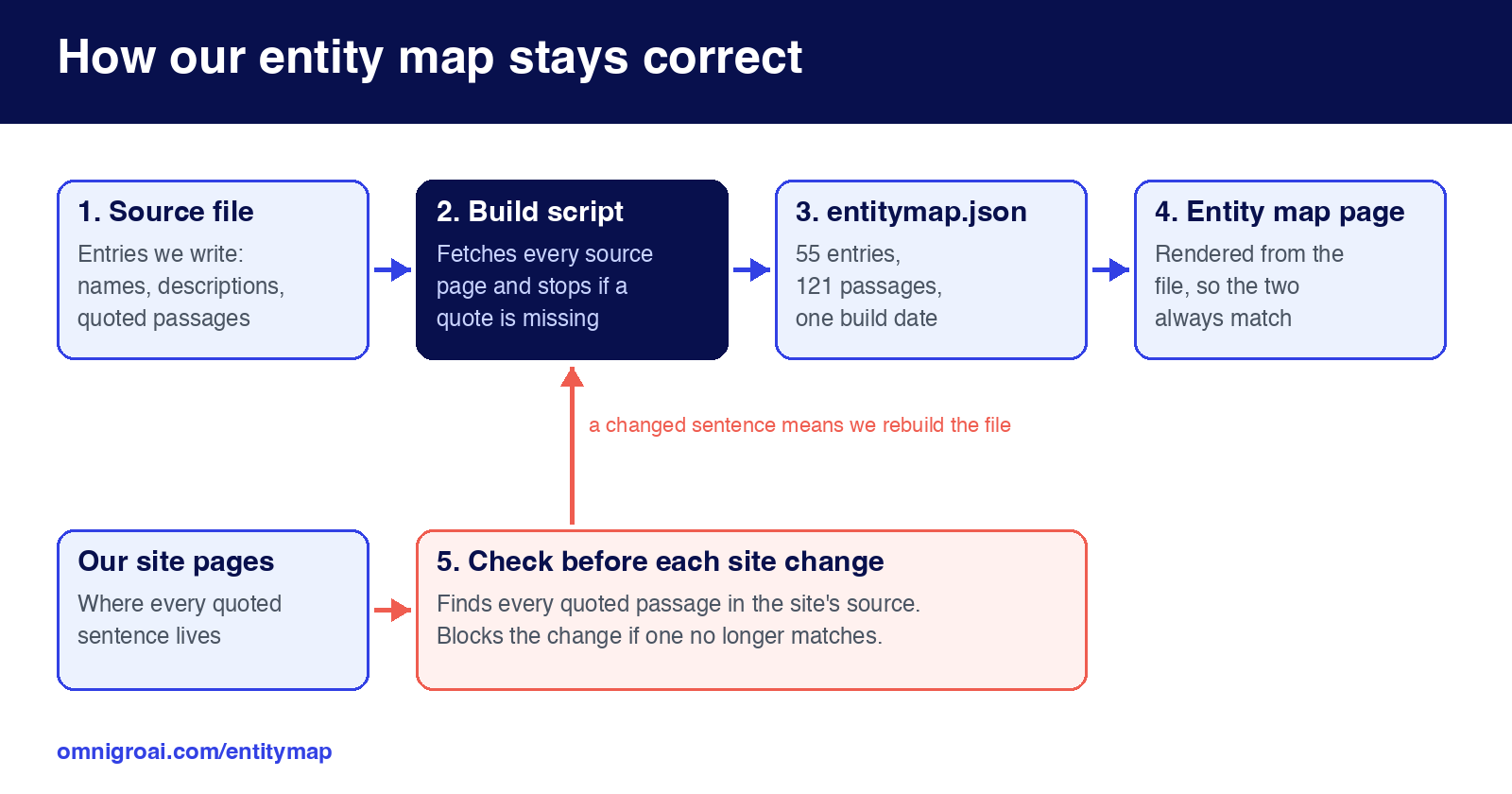
We built our entity map in one working day. It has 55 entries backed by 121 quoted passages from 35 pages. We wrote the entries with an AI assistant, and our founder reviewed the map before it went live. Every mechanical check went to a script, because a model that picks a passage can also misquote it.
The build ran in five steps:
- We listed the entries. Ours include 19 services, 12 guides, 9 terms, 5 differentiators and 2 clients. The rest cover the company, its people and its programme memberships.
- We wrote each description. Every entry gets one to three sentences, and most get links: we offer this service, this guide explains that term.
- We picked the passages. Each entry quotes sentences from our live pages, word for word, with the page they came from.
- A script built the file. It checks the spec's rules, fetches every source page and stops if a quoted sentence is missing.
- The site renders the file. Our entity map page takes every entry from the file, so the two always match.
This is one entry from our file, shortened:
{
  "entityId": "e_037",
  "@type": "Concept",
  "name": "Fan-out queries",
  "description": "Fan-out queries are the follow-up searches an AI engine runs behind a prompt.",
  "hasChunks": [
    {
      "text": "Fan-out query capture: the follow-up searches AI engines run behind each tracked prompt, so our content answers them",
      "sourceUrl": "https://www.omnigroai.com/pricing/"
    }
  ]
}
We left two things out. The format lets a publisher score how relevant each passage is, but the spec gives no method, so any score would be our guess. It also asks for a link from each general concept to Wikidata, the public database behind Wikipedia, or to Wikipedia itself. Three of our six concepts have no entry, so we left them unlinked.
What building the entity map showed us about our own site
An entity map can only quote what your site already says. When we wrote ours, we had to find one sentence on our site for every fact about us, and that search turned up three problems. We have fixed one so far.
- Our AI Citation Tracking page named six AI engines, while our industry pages name five.
- Our features list still showed a service we retired in September.
- Our sales emails said our founder worked as a software engineer for more than 15 years. No page on the site said it.
We wanted our founder's background on the map, so we first added a sentence to our company page and then quoted it. Other claims from our sales emails are still off the map, because no page states them yet.
When your pages disagree, an AI assistant usually hedges, picks one version, or leaves you out. We explain why in our guide to entity optimization for AI. We run the same comparison across third-party sources for clients, as Entity Consistency Monitoring.
How we keep the entity map current
A quote goes wrong the day someone edits the sentence it came from. We keep our entity map current with two automatic checks, and neither one uses a model. One runs when we build the file, and one runs before we save any change to the site's pages.
The build check reads the live site. It fetches all 35 source pages and compares each of the 121 passages against the text on the page. If one sentence has changed, the build stops and names it.
The second check sits in the website's code. Before we save a change, it looks for every quoted passage in the site's source files. We tested it by rewording one sentence on our company page, and it blocked the change and named the passage it broke.
So a copy change and its quote now ship together. We edit the page, update the passage, rebuild against a local copy of the site and save both.
The file also carries a build date. The spec says a date more than 30 days old "signals potential staleness". Our pre-save check warns us once the file passes that age.
What we are measuring, and the results so far
We are tracking three things and will add each result to this section as it comes in, including the ones that show no change:
- How often our tracked AI answers retrieve or cite the entity map page.
- Citations of the page in Bing's AI performance report.
- When Google indexes the page, and its impressions in Search Console.
25 November 2026. We published the page and the file, submitted the page to IndexNow, which tells Bing and other search engines about new pages. We also asked Google to index it. Search Console listed the page as unknown to Google at that point. We have no results to report yet.
FAQs
Is an entity map the same as llms.txt?
No. An llms.txt file lists a site's important pages for an AI system to read. An entity map lists the things those pages describe, with a definition and quoted evidence for each. A site can publish both.
How many entries does a small business need?
Start with about ten. The spec sets no minimum beyond one entry, and it only asks you to split the file above 200. One of the format's authors lists 15 entries on his own site, and ours has 55.
Do I need a developer to build an entity map?
You can write the file by hand and test it with the free EntityMap validator. The automatic checks took us code. Without them you need to re-read every quoted passage each time your site changes.
How long does an entity map take to build?
Ours took one working day for 55 entries, including the script and the page.
Where to start
List ten entries: your company, the people behind it, and each service with its price. For each one, find the sentence on your site that states it. Where you find two versions or none, you have found where ChatGPT has to guess about you. If you want to see what AI says about your brand today, book a free AI visibility assessment.